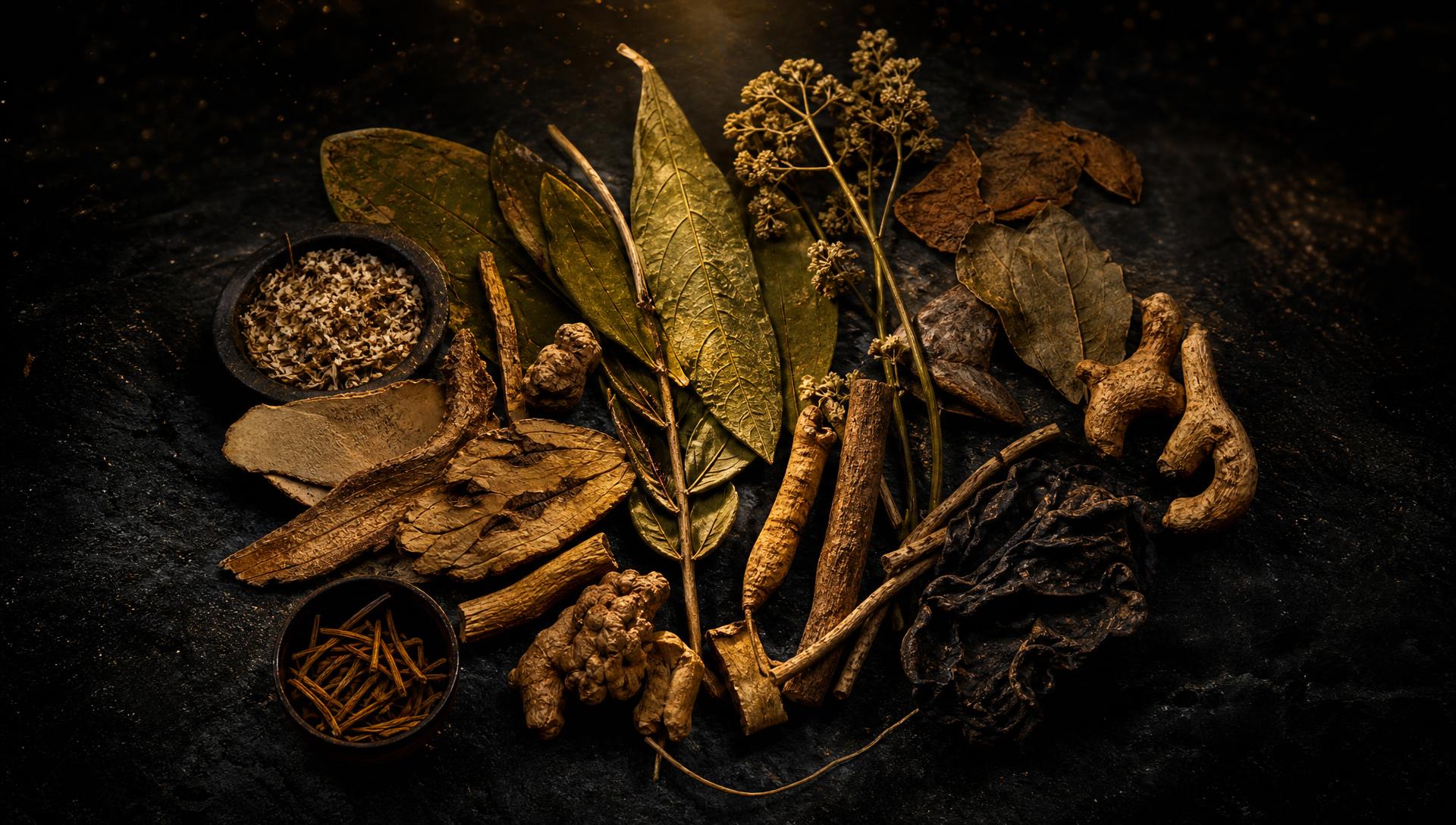
A curated library of healing knowledge.
From the oldest known health texts to peer-reviewed modern research — Indian, Chinese, Greek, Arabic, and Western sources. Every book is shown in plain English first; the original title stays underneath for scholars.
- I · Foundational Traditions~300 BCE
The Charaka Compendium
Charaka Saṃhitā · चरकसंहिताCharaka (redaction of Agniveśa) · ĀyurvedaThe Kāyacikitsā cornerstone — internal medicine, body-humor theory, dietetics, ethics of the physician, and the eight branches of Āyurveda.
“Yathā piṇḍe tathā brahmāṇḍe” — As in the body, so in the cosmos.
- I · Foundational Traditions~600 BCE
The Sushruta Compendium (Surgery)
Suśruta Saṃhitā · सुश्रुतसंहिताSuśruta · ĀyurvedaThe world's first systematic surgery — 121 instruments, 300 procedures, rhinoplasty, cataract couching, and the vital point points.
“Śastra-karma pradhānaḥ” — Among physicians, the surgeon is foremost.
- I · Foundational Traditions6th century CE
The Heart of the Eight Branches
Aṣṭāṅga Hṛdayam · अष्टाङ्गहृदयम्Vāgbhaṭa · ĀyurvedaThe synthesizing heart — distilling Charaka and Suśruta into a single elegant compendium still taught verbatim today.
“Hitāhitaṃ sukhaṃ duḥkhaṃ āyus tasya hitāhitam” — The good life is the life that protects life.
- I · Foundational Traditions~200 BCE
The Yellow Emperor's Inner Classic
Huángdì Nèijīng · 黃帝內經Yellow Emperor tradition · TCMThe Sūwèn and Língshū — meridians, qi, yin-yang, the five-phase theory, and the foundational dialogues of Chinese medicine.
“上工治未病” — The superior physician treats illness before it arises.
- I · Foundational Traditions220 CE
Treatise on Cold Damage
Shānghán Lùn · 傷寒論Zhāng Zhòngjǐng · TCMCold-damage and febrile disease — 113 formulae organized by the six channels. The clinical bedrock of every Chinese herbalist since.
“辨證論治” — Treat the pattern, not the disease.
- I · Foundational Traditions1578
Compendium of Materia Medica (Li Shizhen)
Běncǎo Gāngmù · 本草綱目Lǐ Shízhēn · TCMThe encyclopedic materia medica (list of medicines) — 1,892 substances, 11,000 prescriptions, 27 years in the writing. Listed by Darwin as one of the world's three great pharmacopeias.
“格物窮理” — Investigate things to exhaust their principle.
- I · Foundational TraditionsSiddha lineage
The Agastya Compendium (Siddha)
Agastya Saṃhitā · अगस्त्य संहिताAgastya Mahāṛṣi tradition · SiddhaThe Siddha pharmacopeia of South India — kayakalpa, mercurial alchemy, varma kalai, and the muppu universal mineral.
“உடல் தான் கோயில்” — The body is the temple.
- I · Foundational Traditions1025
The Canon of Medicine (Avicenna)
Al-Qānūn fī al-Ṭibb · القانون في الطبIbn Sīnā (Avicenna) · UnaniThe Canon of Medicine — five books fusing Greek humoral theory with Indo-Persian pharmacology. The medical textbook of Europe for 600 years.
“The knowledge of anything, since all things have causes, is not acquired unless its causes are known.”
- I · Foundational Traditions50–70 CE
On Medical Materials (Dioscorides)
Pedanius Dioscorides · Greco-RomanThe Roman empire's botanical bible — 600 plants, 1000 medicines, observed in the field across the legions' campaigns.
“To know the plant is to know the cure.”
- I · Foundational Traditions5th c. BCE
Corpus Hippocraticum
Hippocrates and school · Greco-RomanSixty treatises that birthed Western clinical observation, the four humors, the oath, and the doctrine of natura medicatrix — nature heals.
“Πρῶτον μὴ βλάπτειν” — First, do no harm.
- I · Foundational Traditions12th century CE
rGyud bzhi (Four Tantras)
rGyud bzhi (Four Tantras) · རྒྱུད་བཞིYutok Yönten Gönpo · TibetanTibet's medical magnum opus — root, explanatory, instructional, and subsequent tantras. Pulse, urinalysis, and the wind-bile-phlegm humors.
“ནད་གསུམ་མཉམ་ན་བདེ་བ་ཡིན།” — When the three humors are balanced, there is wellness.
- I · Foundational Traditions1653
Culpeper's Complete Herbal
Nicholas Culpeper · Western HerbalAstrological herbalism for the common Englishman — every plant assigned a planetary ruler, every remedy democratized away from the College of Physicians.
“The physician without astrology is like a lamp without oil.”
- I · Foundational Traditions1600 BCE (copy of ~3000 BCE original)
Edwin Smith Surgical Papyrus
Imhotep tradition (scribal copy) · KemeticForty-eight surgical cases — the earliest scientific case method, listing examination, diagnosis, treatment, and prognosis with no magic.
“An ailment which I will treat / which I will contend with / not to be treated.”
- I · Foundational Traditions16th century CE
Bhava Prakash — Illuminator of Nature
Bhāva Prakāśa · भावप्रकाशBhāva Miśra · ĀyurvedaThe last of the great Āyurvedic trios — first to catalog New World materials (chopcheeni, Smilax china), updating Charaka's nighantu for a globalized pharmacopeia.
“Dravyaṃ body-humor-praśamanam” — A substance is defined by what it pacifies.
- I · Foundational Traditions7th century CE
Mādhava Nidānam
Mādhava Nidānam · माधवनिदानम्Mādhavakara · ĀyurvedaThe diagnostic gold-standard — root causes, prodromes, signs, complications, and the differential diagnosis of every classical disease.
“diagnosis pañcakam” — Five-fold diagnosis: cause, prodrome, sign, palpation, complication.
- I · Foundational TraditionsHan Dynasty compilation
The Divine Farmer's Herbal Classic
Shénnóng Běncǎo Jīng · 神農本草經Shénnóng tradition · TCMThe Divine Farmer's classic — 365 substances classified upper (life-extending), middle (tonic), lower (toxic but curative). The seed of all Chinese herbalism.
“神農嘗百草” — Shénnóng tasted the hundred herbs.
- I · Foundational Traditions13th century CE
The Sharngadhara Formulary
Śārṅgadhara Saṃhitā · शार्ङ्गधरसंहिताŚārṅgadhara · ĀyurvedaThe pharmacological cookbook — defining dosage, weights, kalpana (preparations), and the first systematic use of opium and metals in Āyurvedic compounding.
“Bheṣajaṃ jñāna-pūrvakam” — Medicine is a function of knowledge applied first.
- II · Philosophy & Ethics~200 BCE
Bhagavad Gītā
Bhagavad Gītā · भगवद्गीताVyāsa (attrib.) · Philosophy of MindOn the field of action, Kṛṣṇa instructs Arjuna in the yoga of the sovereign Self — knowledge, devotion, and disciplined work.
“Yogaḥ karmasu kauśalam — Yoga is skill in action.”
- II · Philosophy & Ethics~375 BCE
Politeia (Republic)
Politeia (Republic) · ΠολιτείαPlato · Ethics & GovernanceThe just city as a magnified human soul. Education of guardians, the philosopher-king, the allegory of the cave.
“Until philosophers are kings, cities will have no rest from their evils.”
- II · Philosophy & Ethics~300 BCE
Arthascience
Arthaśāstra · अर्थशास्त्रKauṭilya (Chāṇakya) · Ethics & GovernanceThe science of statecraft, economics, espionage, and law from the Mauryan court — perhaps the most complete pre-modern political manual.
“The root of wealth is economic activity; lack of it brings material distress.”
- II · Philosophy & Ethics~170 CE
Meditations
Meditations · Τὰ εἰς ἑαυτόνMarcus Aurelius · Human ExperiencePrivate notebooks of a Roman emperor — Stoic discipline applied at the apex of worldly power.
“You have power over your mind — not outside events.”
- II · Philosophy & Ethics~6th c. BCE
Tao Te Ching
Tao Te Ching · 道德經Lao Tzu · Human ExperienceEighty-one verses on the Way that cannot be named, on wu-wei, and on governance through non-interference.
“The Tao that can be told is not the eternal Tao.”
- II · Philosophy & Ethics1946
Man's Search for Meaning
Viktor Frankl · Human ExperienceA psychiatrist's testimony from the camps and the founding text of logotherapy — meaning as the irreducible human need.
“He who has a why to live can bear almost any how.”
- II · Philosophy & Ethics1883–1885
Also sprach Zarathustra
Friedrich Nietzsche · Human ExperienceThe prophet of the Übermensch — the transvaluation of values, eternal recurrence, the death of god as opening, not loss.
“Man is a rope, tied between beast and Übermensch — a rope over an abyss.”
- II · Philosophy & Ethics2011
Sapiens
Yuval Noah Harari · Human ExperienceA species history through three revolutions — cognitive, agricultural, scientific — and the fictions that bind eight billion strangers.
“Large numbers of strangers can cooperate by believing in common myths.”
- II · Philosophy & Ethics2014
Superintelligence
Nick Bostrom · AI & SocietyPaths, dangers, and strategies for the arrival of machine intellect that surpasses our own. The first systematic existential-risk treatise.
“The first ultraintelligent machine is the last invention that man need ever make — provided it is docile.”
- II · Philosophy & Ethics2019
Human Compatible
Stuart Russell · AI & SocietyRedefining AI around provable deference to human preferences — assistance games as the antidote to misspecified objectives.
“The machine's only objective is to maximize the realization of human preferences.”
- II · Philosophy & Ethics2023
The Coming Wave
Mustafa Suleyman · AI & SocietyAI and synthetic biology as a containment problem at civilizational scale — the asymmetry between proliferation and governance.
“Containment is the overarching task of our era.”
- II · Philosophy & Ethics2021
The Age of AI
Kissinger, Schmidt & Huttenlocher · AI & SocietyStatesman, technologist, and academic on AI as a reshaping of identity, knowledge, diplomacy, and war.
“We are at the dawn of an era in which decisions will be made by processes we cannot fully understand.”
- II · Philosophy & Ethics2020
The Alignment Problem
Brian Christian · AI & SocietyHow specification, fairness, and value-loading actually fail in the lab — the field's history told through its hardest failures.
“The story of AI is the story of trying to write down what we want.”
- III · Plant Science & Frontier Research1558
Bhāvaprakāśa materia-medica dictionary
Bhāvaprakāśa Nighaṇṭu · भावप्रकाशनिघण्टुBhāva Miśra · Plant IntelligenceThe standard medieval Āyurvedic materia medica (list of medicines) — properties, synonyms, energetics, and clinical use of 470+ plants, minerals, and animal drugs.
“Rasa, vīrya, vipāka, prabhāva — by these four a substance acts.”
- III · Plant Science & Frontier Research~15th c.
The Royal Materia Medica (Raja Nighantu)
Rāja Nighaṇṭu · राजनिघण्टुNarahari Paṇḍita · Plant IntelligenceEncyclopedic Kashmiri lexicon of medicinal plants with regional synonyms — the bridge between Himalayan and peninsular pharmacognosy.
“One herb, a hundred names; one virtue, a hundred uses.”
- III · Plant Science & Frontier Research1678–1693
Hortus Malabaricus
Hendrik van Rheede (with Itty Achuden) · Plant IntelligenceTwelve folio volumes documenting 742 Malabar plants with Ezhava traditional uses — the first systematic ethnobotany of South India.
“The vaidya knew the plant before Linnaeus named it.”
- III · Plant Science & Frontier Research2002
The Lost Language of Plants
Stephen Harrod Buhner · Plant IntelligenceHow industrial pharmacology severed the dialogue with the plant world — and the somatic, perceptual practice required to restore it.
“Plants are not background. They are interlocutors.”
- III · Plant Science & Frontier Research1979
Plants of the Gods
Schultes, Hofmann & Rätsch · Plant IntelligenceThe botanical, chemical, and ritual atlas of psychoactive plants across all cultures — the standard reference of ethnopharmacology.
“There is no people on Earth that has not sought out the plants of vision.”
- III · Plant Science & Frontier Research~200 BCE
Yoga Sūtras
Yoga Sūtras · योगसूत्रPatañjali · Cosmology & Yoga196 aphorisms defining yoga as the cessation of mental fluctuations — and the eightfold path that achieves it.
“Yogaścittavṛttinirodhaḥ — Yoga is the stilling of the mind's whirling.”
- III · Plant Science & Frontier Research~15th c.
Light on Hatha Yoga
Haṭha Yoga Pradīpikā · हठयोगप्रदीपिकाSvātmārāma · Cosmology & YogaThe classical manual of haṭha — āsana, prāṇāymetabolic residue (ama), mudrā, bandha, nāda — as preparation for the rāja path.
“The mind is the king of the senses; the breath is the king of the mind.”
- III · Plant Science & Frontier Research~15th c.
The Shiva Compendium (Yoga)
Śiva Saṃhitā · शिवसंहिताAnonymous (Śaiva tradition) · Cosmology & YogaA complete tantric-yogic treatise on the subtle body, energy-centers, energy-channels, and the practitioner's progressive realization.
“Within this body is Mount Meru, encircled by all the planets.”
- III · Plant Science & Frontier Research~7th c. CE
Vijñāna Bhairava Tantra
Vijñāna Bhairava Tantra · विज्ञानभैरवतन्त्रKashmir Śaiva tradition · Cosmology & Yoga112 dhāraṇās — micro-practices on breath, sound, sense, and void — by which consciousness recognizes itself.
“Between two breaths, the supreme reality shines.”
- III · Plant Science & Frontier Research~4th–5th c. CE
Sūrya Siddhānta
Sūrya Siddhānta · सूर्यसिद्धान्तAnonymous (received tradition) · Cosmology & YogaSanskrit astronomy — planetary periods, eclipses, precession, sine tables — the engine behind the pañcāṅga we still compute today.
“Time is the wheel; the planets are its spokes.”
- III · Plant Science & Frontier Research1985
The Body Electric
Robert O. Becker & Gary Selden · Frontier ScienceBioelectricity, regeneration, and the suppressed science of how living tissue heals itself through endogenous DC fields.
“The body is, at its root, an electrical engine.”
- III · Plant Science & Frontier Research1997
Molecules of Emotion
Candace B. Pert · Frontier ScienceNeuropeptide receptors across the entire body — proving the mind-body system is one biochemical conversation, not two.
“The body is the unconscious mind.”
- III · Plant Science & Frontier Research2020
Entangled Life
Merlin Sheldrake · Frontier ScienceFungi as the planet's distributed intelligence — mycorrhizal networks, decomposition, and the dissolution of the individual.
“To understand life, study what eats it.”
- III · Plant Science & Frontier Research1996
The Web of Life
Fritjof Capra · Frontier ScienceA systems-theoretic synthesis of biology, cybernetics, and ecology — living systems as self-organizing patterns of relation.
“Life is not a substance. It is a pattern.”
- III · Plant Science & Frontier Research2006
Quantum Enigma
Bruce Rosenblum & Fred Kuttner · Frontier ScienceWhy physics' encounter with consciousness will not go away — the measurement problem stated honestly for non-physicists.
“Quantum mechanics is the most successful theory we have, and nobody understands it.”
- III · Plant Science & Frontier Research2011
Debt: The First 5,000 Years
David Graeber · Society & EconomyMoney as a ledger of obligation — and the long oscillation between credit empires and bullion empires that defines history.
“Markets are not the opposite of states. They are made by them.”
- III · Plant Science & Frontier Research1998
Seeing Like a State
James C. Scott · Society & EconomyWhy high-modernist legibility schemes — from scientific forestry to planned cities — repeatedly fail the human terrain.
“Mētis — local, practical knowledge — is what the state cannot see.”
- III · Plant Science & Frontier Research2021
The Dawn of Everything
David Graeber & David Wengrow · Society & EconomyA rewriting of human prehistory — political experimentation, seasonal sovereignty, and the recovery of our species' lost imagination.
“We are projects of collective self-creation.”
- IV · Global Materia Medica1597
The Herball, or Generall Historie of Plantes
John Gerard · Global Materia MedicaElizabethan England's great folio of plants — 1,800 woodcuts, virtues, and field observation; the seedbed of English botanical medicine.
“Who would looke dangerously up at Planets, that might safely looke down at Plants?”
- IV · Global Materia Medica~1550 BCE
Ebers Papyrus
Anonymous Egyptian scribes · Global Materia MedicaTwenty metres of hieratic medicine — 700 remedies and incantations spanning gynecology, ophthalmology, dentistry, and parasitology.
“Heart speaketh out of the vessels of every limb.”
- IV · Global Materia Medica~168 BCE
Wǔshí'èr Bìngfāng
Wǔshí'èr Bìngfāng · 五十二病方Mawangdui silk texts · Global Materia MedicaRecipes for Fifty-Two Ailments — the earliest extant Chinese clinical handbook, exhumed from a Han tomb.
“For every affliction, a recipe; for every recipe, a witness.”
- IV · Global Materia Medica1700
Tibb-i-Akbarī
Tibb-i-Akbarī · طب اکبریMuḥammad Akbar Arzānī · Global Materia MedicaMughal-era Unani compendium synthesising Arab, Persian, and Indian medicine for the court of Aurangzeb.
“Mizāj is the music; medicine is the tuning.”
- IV · Global Materia Medica1488
Compendium Aromatariorum
Saladin of Ascoli · Global Materia MedicaThe apothecary's manual of medieval Europe — weights, substitutions, storage, and the ethics of the dispensing pharmacist.
“Quod non est in materia, non est in arte.”
- IV · Global Materia Medica1552
Libellus de Medicinalibus Indorum Herbis (Badianus Manuscript)
Martín de la Cruz, tr. Juan Badianus · Indigenous & Folk WisdomAn Aztec herbal painted at the Colegio de Santa Cruz — Nahua medicine recorded in colour by its own physicians.
“The herb that the Indian knows, the Indian shall name.”
- IV · Global Materia Medica1577
Florentine reader (Historia General)
Bernardino de Sahagún with Nahua elders · Indigenous & Folk WisdomTwelve books of Nahua knowledge — including Book XI's encyclopedic catalogue of plants, animals, minerals, and their uses.
“So that the ancient wisdom be not lost.”
- IV · Global Materia Medica1648
Historia Naturalis Brasiliae
Willem Piso & Georg Marcgrave · Indigenous & Folk WisdomThe first systematic natural history of the New World tropics — Tupi medicine, jaborandi, ipecac, curare and the Brazilian pharmacopeia.
“Every river bend a new pharmacy.”
- IV · Global Materia Medica~9th c.
Bald's Leechbook
Anglo-Saxon compilation · Indigenous & Folk WisdomOld English remedies bridging Mediterranean theory and northern folk practice — including a 2015 reconstruction effective against MRSA.
“Wið every wound, a wyrt; wið every sorrow, a song.”
- IV · Global Materia Medica~13th c.
Meddygon Myddfai (Physicians of Myddfai)
Llanddeusant lineage · Indigenous & Folk WisdomWelsh hereditary medicine — herbal, dietetic, and astrological lore transmitted across generations from the Lady of the Lake.
“Whoever heals the body must first quiet the mind.”
- IV · Global Materia Medica13th c.
Rasaratna Samuccaya
Rasaratna Samuccaya · रसरत्नसमुच्चयVāgbhaṭa II · Historical Materia & ChemistryThe Indian alchemical bible — mercury (rasa), mica, sulphur, and the eighteen saṃskāras that turn mineral into medicine.
“Mercury bound is the body's amrita.”
- IV · Global Materia Medica1996
Towards a Safer Choice: Chinese Herbal Medicine in Australia
Alan Bensoussan & Stephen Myers · Modern Integrative ScienceThe landmark regulatory-clinical audit that opened the West to evidence-based traditional pharmacy.
“Tradition is a hypothesis with five thousand years of data.”
- IV · Global Materia Medica1995
Spontaneous Healing
Andrew Weil · Modern Integrative ScienceThe body's self-repair system framed clinically — diet, breath, plants, and time as the integrative physician's primary tools.
“The greatest discovery in medicine is the healing system within.”
- IV · Global Materia Medica2005
The Biology of Belief
Bruce Lipton · Modern Integrative ScienceEpigenetics, cell-membrane signalling, and the case that environment and perception write the genome's expression.
“Genes are the blueprint; perception is the contractor.”
- IV · Global Materia Medica2002–2012
Textbook of Ayurveda (Vol. I–III)
Vasant Lad · Modern Integrative ScienceThe modern English clinical exposition of Āyurveda — body-humor, body-tissue, srotas, and pulse diagnosis taught for the contemporary practitioner.
“The pulse is the river; the physician, the listener on its bank.”
- IV · Global Materia Medica1999
Yoga and Ayurveda: Self-Healing and Self-Realization
David Frawley · Modern Integrative ScienceThe reunification of the sister disciplines — life-breath (life-breath (prana)), tejas, ojas as the bridge between yogic practice and Āyurvedic therapy.
“Yoga without Āyurveda is a tree without roots.”
- V · Antiquity to Modern Science~1500 BCE
Rig Veda — Hymns of Knowledge
Ṛgveda · ऋग्वेदṚṣis of the Sapta Sindhu · Ancient FoundationsThe oldest surviving Indo-European scripture — 1,028 hymns to fire, soma, dawn, and cosmic order; the seed of medicine, mantra, and metaphysics.
“Ekaṃ sad viprā bahudhā vadanti — Truth is one, the wise call it by many names.”
- V · Antiquity to Modern Science~1000 BCE
Atharva Veda — Everyday Healing
Atharvaveda · अथर्ववेदAtharvan & Aṅgiras lineages · Ancient FoundationsThe Veda of healing and household — herbal charms, surgical hymns, longevity mantras; the proto-medical corpus that precedes Charaka.
“Tryāyuṣaṃ jamadagneḥ — Let life be threefold and complete.”
- V · Antiquity to Modern Science~800–300 BCE
Principal Upaniṣads
Principal Upaniṣads · उपनिषद्Anonymous ṛṣis · Ancient FoundationsThirteen dialogues at the forest's edge — Brahman, Ātman, the five sheaths, the breath, the witness; the philosophical spine of Yoga.
“Tat tvam asi — That thou art.”
- V · Antiquity to Modern Science~200 BCE
Yoga Sūtras
Yoga Sūtras · योगसूत्राणिPatañjali · Ancient Foundations196 aphorisms compressing the entire science of the mind — the eight limbs, the kleśas, samādhi, and the cessation of mental modification.
“Yogaś citta-vṛtti-nirodhaḥ — Yoga is the stilling of the mind's whirlpools.”
- V · Antiquity to Modern Science~400 BCE
Dào Dé Jīng
Dào Dé Jīng · 道德經Lǎozǐ (attrib.) · Ancient FoundationsEighty-one verses on the Way that cannot be named — the soft overcoming the hard, the sage who governs without ruling.
“The Way that can be spoken is not the eternal Way.”
- V · Antiquity to Modern Science~475 BCE
Lúnyǔ (Analects)
Lúnyǔ (Analects) · 論語Disciples of Kǒngzǐ · Ancient FoundationsConversations of Confucius — ren, li, the rectification of names, and the ethics of the gentleman-scholar.
“Do not impose on others what you do not desire.”
- V · Antiquity to Modern Science~3rd c. BCE
Dhammapada
Dhammapada · धम्मपदCompiled disciples of the Buddha · Ancient Foundations423 Pāli verses on the path — mind preceding all phenomena, the cooling of craving, the architect of the house exposed.
“Mind is the forerunner of all things; mind is chief; they are mind-made.”
- V · Antiquity to Modern Science~3rd c. BCE
Zhuāngzǐ
Zhuāngzǐ · 莊子Zhuāng Zhōu et al. · Ancient FoundationsParables of butterflies, cooks, and useless trees — Daoism made wild, paradoxical, and free; the laughter inside the cosmos.
“The perfect man uses his mind like a mirror — grasping nothing, refusing nothing.”
- V · Antiquity to Modern Science16th c. (oral antiquity)
Popol Vuh
K'iche' Maya elders · Ancient FoundationsThe Maya book of origins — the Hero Twins, the maize humans, and the cosmogenesis of a civilization rooted in corn and time.
“And the maize entered into their flesh, and so we became human.”
- V · Antiquity to Modern Science712 CE
Kojiki
Kojiki · 古事記Ō no Yasumaro · Ancient FoundationsJapan's oldest chronicle — kami, izanagi-izanami, amaterasu; the mythic substrate of Shinto medicine and forest reverence.
“In the beginning, heaven and earth had not yet parted.”
- V · Antiquity to Modern Science~300 BCE
Στοιχεῖα (Elements)
Euclid · Mathematics & CosmosThirteen books that built the axiomatic method — geometry, number theory, and the irrationals; the most-printed scientific work in history.
“Quod erat demonstrandum.”
- V · Antiquity to Modern Science499 CE
Āryabhaṭīya
Āryabhaṭīya · आर्यभटीयĀryabhaṭa · Mathematics & CosmosPlace-value, the sine table, planetary periods, and the rotation of the Earth — Indian mathematical astronomy in 121 verses.
“The Earth rotates while the stars stand still.”
- V · Antiquity to Modern Science~150 CE
Almagest
Almagest · Μαθηματικὴ ΣύνταξιςClaudius Ptolemy · Mathematics & CosmosThe geocentric synthesis — epicycles, the star catalogue, the model that ruled cosmology for fourteen centuries.
“Each thing in heaven moves in a circle perfect and eternal.”
- V · Antiquity to Modern Science1687
Philosophiæ Naturalis Principia Mathematica
Isaac Newton · Mathematics & CosmosThree laws of motion and universal gravitation — calculus pressed into the service of the heavens.
“If I have seen further, it is by standing on the shoulders of giants.”
- V · Antiquity to Modern Science1916
Relativity: The Special and General Theory
Albert Einstein · Mathematics & CosmosSpacetime as a single fabric, gravitation as curvature — the relativistic universe explained for the educated reader.
“Matter tells spacetime how to curve; spacetime tells matter how to move.”
- V · Antiquity to Modern Science1985
QED: The Strange Theory of Light and Matter
Richard Feynman · Mathematics & CosmosQuantum electrodynamics rendered as little arrows — the most accurate theory ever tested, narrated as a fireside chat.
“Nature isn't classical, and if you want to simulate her, you'd better make it quantum mechanical.”
- V · Antiquity to Modern Science1988
A Brief History of Time
Stephen Hawking · Mathematics & CosmosSingularities, event horizons, the arrow of time — a cosmologist's invitation to think about the universe whole.
“Time itself begins with the Big Bang.”
- V · Antiquity to Modern Science2002
A New Kind of Science
Stephen Wolfram · Mathematics & Cosmos1,280 pages arguing that simple computational rules generate the complexity of nature — cellular automata as physics.
“Computational equivalence is a principle as deep as conservation of energy.”
- V · Antiquity to Modern Science2004
The Road to Reality
Roger Penrose · Mathematics & CosmosA complete mathematical scaffold of modern physics — from fibre bundles to twistor theory, drawn by the author's own hand.
“The truths of mathematics are not made; they are discovered.”
- V · Antiquity to Modern Science1982
The Fractal Geometry of Nature
Benoît Mandelbrot · Mathematics & CosmosCoastlines, clouds, lungs, lightning — the geometry of roughness; a new language for the broken shapes of the real world.
“Clouds are not spheres, mountains are not cones.”
- V · Antiquity to Modern Science1859
On the Origin of Species
Charles Darwin · Biology & MindVariation, inheritance, and natural selection — the single idea that reorganised every life science that followed.
“Endless forms most beautiful and most wonderful have been, and are being, evolved.”
- V · Antiquity to Modern Science1962
Silent Spring
Rachel Carson · Biology & MindThe chemical poisoning of the food web — the book that founded the modern environmental movement and re-grounded medicine in ecology.
“In nature nothing exists alone.”
- V · Antiquity to Modern Science1968
The Double Helix
James Watson · Biology & MindAn insider's narrative of DNA's structural discovery — and a record of the credit politics that shape biological knowledge.
“We have found the secret of life.”
- V · Antiquity to Modern Science1976
The Selfish Gene
Richard Dawkins · Biology & MindThe gene-centred view of evolution — bodies as vehicles, memes as cultural replicators; a frame that still organises biology.
“We are survival machines — robot vehicles blindly programmed to preserve the selfish molecules called genes.”
- V · Antiquity to Modern Science1979
Gaia: A New Look at Life on Earth
James Lovelock · Biology & MindThe Earth as a self-regulating organism — atmospheric chemistry as evidence that life shapes its own conditions.
“The Earth is alive; it always has been.”
- V · Antiquity to Modern Science2014
The Body Keeps the Score
Bessel van der Kolk · Biology & MindTrauma rewriting brain and body — and the somatic, relational, and contemplative therapies that can rewrite it back.
“The body keeps the score: if the memory of trauma is encoded in the body, the body must be the way out.”
- V · Antiquity to Modern Science1997
Molecules of Emotion
Candace Pert · Biology & MindNeuropeptides as the biochemical substrate of feeling — emotions as system-wide messengers, not brain-only events.
“Your body is your subconscious mind.”
- V · Antiquity to Modern Science2016
I Contain Multitudes
Ed Yong · Biology & MindThe microbial worlds that constitute us — symbiosis as the rule, not the exception; the body as ecosystem.
“Animals are walking, talking ecosystems.”
- V · Antiquity to Modern Science2010
The Emperor of All Maladies
Siddhartha Mukherjee · Biology & MindA biography of cancer from antiquity to oncogenes — the long arc of how a civilization learns to fight an illness.
“Cancer is not a foreign invader; it is our own distorted self.”
- V · Antiquity to Modern Science2006
In Search of Memory
Eric Kandel · Biology & MindSynapse to self — a Nobel laureate's life work tracing how molecules at the synapse become the experience of remembering.
“We are what we remember.”
- V · Antiquity to Modern Science1949
A Sand County Almanac
Aldo Leopold · Ecology & EarthThe land ethic — a moral grammar that extends community to soils, waters, plants, and animals; conservation as character.
“A thing is right when it tends to preserve the integrity, stability, and beauty of the biotic community.”
- V · Antiquity to Modern Science1975
The One-Straw Revolution
Masanobu Fukuoka · Ecology & EarthDo-nothing farming — no tillage, no fertiliser, no pesticide; agriculture as a discipline of letting the land instruct.
“The ultimate goal of farming is not the growing of crops, but the cultivation of human beings.”
- V · Antiquity to Modern Science1988
Permaculture: A Designer's Manual
Bill Mollison · Ecology & EarthThe encyclopedic foundation of permaculture — zones, sectors, guilds, and the design science of regenerative human habitats.
“The only ethical decision is to take responsibility for our own existence and that of our children.”
- V · Antiquity to Modern Science2013
Braiding Sweetgrass
Robin Wall Kimmerer · Ecology & EarthIndigenous wisdom and scientific botany braided together — gratitude, reciprocity, and the grammar of animacy.
“All flourishing is mutual.”
- V · Antiquity to Modern Science2015
The Hidden Life of Trees
Peter Wohlleben · Ecology & EarthThe wood-wide web — mycorrhizal communication, kin recognition, and the slow social life of forests.
“A tree can only be as strong as the forest that surrounds it.”
- V · Antiquity to Modern Science2020
Entangled Life
Merlin Sheldrake · Ecology & EarthFungi as the connective tissue of the biosphere — psilocybin, lichens, mycoremediation, and the limits of individuality.
“Fungi make us question what it means to be an individual.”
- V · Antiquity to Modern Science2018
The Overstory
Richard Powers · Ecology & EarthA novel as ecological argument — nine lives convened around the trees that outlast every human protagonist.
“The best arguments in the world won't change a person's mind. The only thing that can do that is a good story.”
- V · Antiquity to Modern Science2019
The Uninhabitable Earth
David Wallace-Wells · Ecology & EarthAn unflinching tour of climate futures — the cascading systems of harm if warming continues unabated.
“It is worse, much worse, than you think.”
- V · Antiquity to Modern Science2022
Regenesis
George Monbiot · Ecology & EarthFeeding the world without devouring it — soil biology, ferment, and the case against livestock-dominated land use.
“The soil is the placenta of the world.”
- V · Antiquity to Modern Science2018
The Wizard and the Prophet
Charles Mann · Ecology & EarthTwo ways to feed ten billion — Borlaug's wizardry of yield against Vogt's prophecy of limits; a generative tension.
“The question is not which is right, but which we have the wisdom to combine.”
- V · Antiquity to Modern Science1936
On Computable Numbers
Alan Turing · Computation & AIThe Turing machine — a definition of computation precise enough to settle the decision problem and seed every computer that followed.
“We may compare a man in the process of computing a real number to a machine.”
- V · Antiquity to Modern Science1948
Cybernetics
Norbert Wiener · Computation & AIControl and communication in the animal and the machine — feedback as the lingua franca of biology, society, and engineering.
“We have modified our environment so radically that we must now modify ourselves.”
- V · Antiquity to Modern Science1948
A Mathematical Theory of Communication
Claude Shannon · Computation & AIInformation as a measurable quantity — entropy, channel capacity, and the noiseless coding theorem; the foundation of the digital world.
“Information is the resolution of uncertainty.”
- V · Antiquity to Modern Science1979
Gödel, Escher, Bach
Douglas Hofstadter · Computation & AISelf-reference as the engine of mind — strange loops binding mathematics, art, music, and the riddle of consciousness.
“The self is a strange loop.”
- V · Antiquity to Modern Science1975
The Mythical Man-Month
Fred Brooks · Computation & AIAdding people to a late project makes it later — software engineering as a humane discipline of communication and limits.
“There is no silver bullet.”
- V · Antiquity to Modern Science1984
Structure and Interpretation of Computer Programs
Abelson & Sussman · Computation & AIThe wizard book — programming as the construction of language, abstraction, and meaning; computation as a liberal art.
“Programs must be written for people to read, and only incidentally for machines to execute.”
- V · Antiquity to Modern Science2016
Deep Learning
Goodfellow, Bengio & Courville · Computation & AIThe reference text of the deep learning era — from linear algebra to convolution, recurrence, and the architectures behind modern AI.
“Depth turns representation into hierarchy.”
- V · Antiquity to Modern Science2017
Attention Is All You Need
Vaswani et al. · Computation & AIThe transformer paper — self-attention replacing recurrence; the architectural seed of every large language model since.
“Attention is all you need.”
- V · Antiquity to Modern Science2019
Human Compatible
Stuart Russell · Computation & AIA redefinition of AI's objective — machines that are provably uncertain about human preferences and provably deferential.
“The right objective for AI is to be uncertain about ours.”
- V · Antiquity to Modern Science2017
Life 3.0
Max Tegmark · Computation & AIA taxonomy of life — hardware, software, and self-redesign; scenarios for an intelligence that can edit its own substrate.
“Intelligence is the ability to accomplish complex goals.”
- V · Antiquity to Modern Science1975
The Tao of Physics
Fritjof Capra · Modern SynthesisParallels between modern physics and Eastern mysticism — a generation's bridge between quantum theory and contemplative traditions.
“Science does not need mysticism and mysticism does not need science — but the human being needs both.”
- V · Antiquity to Modern Science1962
The Structure of Scientific Revolutions
Thomas Kuhn · Modern SynthesisParadigms, normal science, and revolutionary shifts — a sociology of how knowledge actually changes.
“The transition between competing paradigms is a conversion experience.”
- V · Antiquity to Modern Science1982
The Tao of Pooh
Benjamin Hoff · Modern SynthesisDaoist principles through a stuffed bear — wu wei, p'u, and the wisdom of accepting one's own nature.
“When you discard arrogance, complexity, you find peace.”
- V · Antiquity to Modern Science1997
The Wheel of Life
Elisabeth Kübler-Ross · Modern SynthesisDeath as the final stage of growth — the dying as teachers; medicine recovering its relationship with mortality.
“It is only when we truly know that we have a limited time on earth that we will live each day to the fullest.”
- V · Antiquity to Modern Science2014
Being Mortal
Atul Gawande · Modern SynthesisMedicine, ageing, and what matters at the end — palliative reasoning as the highest form of clinical art.
“Endings matter, not just for the dying but, perhaps even more, for the ones left behind.”
- V · Antiquity to Modern Science2018
How to Change Your Mind
Michael Pollan · Modern SynthesisThe renaissance of psychedelic science — psilocybin, LSD, and the default-mode network as the modern frontier of consciousness medicine.
“The mind is its own place, and in itself can make a heaven of hell.”
- V · Antiquity to Modern Science2023
Outlive
Peter Attia · Modern SynthesisMedicine 3.0 — longevity framed around the four horsemen, healthspan over lifespan, and a strategic approach to chronic disease.
“The goal is not to live forever; it is to live well, for as long as possible.”
- V · Antiquity to Modern Science2017
Why We Sleep
Matthew Walker · Modern SynthesisThe neuroscience of sleep as the third pillar of health — memory consolidation, immune repair, and the cost of sleep debt.
“Sleep is the single most effective thing we can do to reset our brain and body health each day.”
- V · Antiquity to Modern Science2020
Breath
James Nestor · Modern SynthesisNasal breathing, mouth taping, and prāṇāymetabolic residue (ama) reframed through modern physiology — the lost art of how to breathe.
“No matter what you eat, how much you exercise, the genes you've inherited — none of it matters unless you're breathing properly.”
- V · Antiquity to Modern Science2019
Deep Medicine
Eric Topol · Modern SynthesisAI in clinical care — the case for using machines to restore the human bond between patient and physician.
“Artificial intelligence can give doctors the gift of time.”
- V · Antiquity to Modern Science1931
On Formally Undecidable Propositions
Kurt Gödel · Frontier & FutureThe incompleteness theorems — every sufficiently powerful formal system contains truths it cannot prove.
“There exist true statements that cannot be proved.”
- V · Antiquity to Modern Science1944
What Is Life?
Erwin Schrödinger · Frontier & FutureThe lectures that hinted at the aperiodic crystal — physics asking biology its own question, and provoking the molecular age.
“Life feeds on negative entropy.”
- V · Antiquity to Modern Science1980
Wholeness and the Implicate Order
David Bohm · Frontier & FutureAn undivided universe enfolded into every part — a physicist's metaphysics that takes consciousness as primary.
“The whole is enfolded in each part.”
- V · Antiquity to Modern Science1991
The Embodied Mind
Varela, Thompson & Rosch · Frontier & FutureCognitive science meets Buddhist phenomenology — enaction, autopoiesis, and the dissolution of the inside-outside divide.
“Cognition is not the representation of a pre-given world, but the enactment of a world.”
- V · Antiquity to Modern Science2017
The Order of Time
Carlo Rovelli · Frontier & FutureTime as relational, granular, and emergent — what physics looks like when the present is abolished.
“The world is not a collection of things; it is a collection of events.”
- V · Antiquity to Modern Science2008
Thinking in Systems
Donella Meadows · Frontier & FutureStocks, flows, feedback loops, and leverage points — a primer for changing complex systems without breaking them.
“The most powerful leverage point is the power to transcend paradigms.”
- V · Antiquity to Modern Science2012
Antifragile
Nassim Nicholas Taleb · Frontier & FutureBeyond resilient — systems that gain from disorder; via negativa, the barbell, and the moral economy of skin in the game.
“Wind extinguishes a candle and energizes fire.”
- V · Antiquity to Modern Science2017
Scale
Geoffrey West · Frontier & FutureUniversal scaling laws of life, cities, and companies — quarter-power exponents that link the metabolism of mice and metropolises.
“Cities are the crucible of civilization, the hub of innovation, but also the source of our problems.”
- V · Antiquity to Modern Science2020
The Ministry for the Future
Kim Stanley Robinson · Frontier & FutureA near-future novel as policy laboratory — carbon coins, refugia, geoengineering, and the institutions that might still save us.
“We are all going to have to do this together.”